Thursday, June 30, 2011

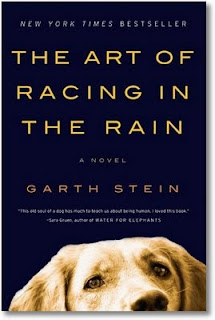
The Art of Racing in the Rain

LEXILE 850

I'm more of a cat-person than a dog-person, and I'm not a huge NASCAR fan, yet I really enjoyed reading The Art of Racing in the Rain by Garth Stein. Go figure.

I was easily drawn into the story about a mechanic/race car driver named Denny which is told through the insightful point of view of his observant and endearing pet dog, Enzo.

So many of life's heart-rending truths are captured in the pages of this strange little book. Enzo's thoughtful commentary on people and society is spot-on, and his philosophical comparisons between life and car-racing are often profound.

“Racing is about discipline and intelligence, not about who has the heavier foot. The one who drives smart will always win in the end.”


“There is no dishonor in losing the race . . . There is only dishonor in not racing because you are afraid to lose.”


“The race is long. It is better to drive within oneself and finish the race behind the others than it is to drive too hard and crash.”


“One can never be angry at another driver for a track accident. One can only be upset at himself for being caught in the wrong place at the wrong time.”


Enzo is a steadfast companion and witness to many of Denny's trials and tribulations, including ongoing financial problems, a family feud, and the death of his wife, Eve. Throughout, Enzo provides gentle support and humor as he passes judgement on everything from hospitals, pharmaceutical companies, and the decimation of the rain forest to euthanasia, loneliness, and the self-destructive nature of humans.

Enzo also has a great sense of humor. This is what he has to say about monkeys.

"Monkeys have thumbs. Practically the dumbest species on the planet, next to the duck-billed platypus, who make their dens underwater even though they breathe air. The platypus is horribly stupid, but is only slightly dumber than a monkey. Yet monkeys have thumbs. Those monkey-thumbs were meant for dogs. Give me my thumbs, you f-ing monkeys!"

The ultimate lesson shared by the dog who longs to be human and his devotion to his race-car-driving master is this gem:
"That which we manifest is before us. The visible become the inevitable. Your car goes where your eyes go."

Friday, June 24, 2011

The Last Days of Ptolemy Grey

"Perhaps they are not stars, but rather openings in Heaven where the love of our lost ones pours through and shines down upon us to let us know they are happy." —Inspired by an Eskimo Legend

Walter Mosley's The Last Days of Ptolemy Grey has replaced A Prayer for Owen Meany as my all-time favorite book. And I couldn't have read it at a more appropriate time. Its message was comforting to me during a time when I needed comfort.

According to Bookmarks Magazine, "Critics described The Last Days of Ptlomey Grey as a remarkable blend of literary fiction, mystery, and fantasy. Most were moved by the story of a man slowly losing himself to dementia and his friendship with the compassionate and pragmatic Robyn . . . And though Mosley's latest is a pretty big departure from his private detective series featuring Easy Rawlins, the novel stands on its own as an original tale of aging, family, love, and loss."

I fell in love with the characters because of their authenticity, and I was touched by the fortitude of the 91-year-old Ptolemy as he reflects on his substantial life lessons, especially those learned in childhood from his mentor, Coy McCann.

Ptolemy wondered how he could have lived for so long but still the most important moments of his life were back when he was a child with Coy McCann walking at his side. How could the most important moments of his life be Coy’s last dance on fire and Maude’s death in flames? Hadn’t he lived through poverty, war, old age? Didn’t any of that mean anything?


For me, the poignant story inspired patience and tolerance for the experiences my own father was going through. Reading about Ptolemy's perspective gave me strength, as if I was receiving solace from a dear and trusted friend.

There are times in your life when things line up and Fate takes a hand in your future,” Ptolemy remembered Coydog saying. “When that happens, you got to move quick and take advantage of the sitchiation or you’ll never know what might have been.”


“How do I know when it’s time to move quick?” L’il Pea asked.


“When somethin’ big happens and then somethin’ else come up.”

Saturday, May 28, 2011

Room

Room: A Novel by Emma Donoghue is one psychological train wreck of a book. I almost gave up on it a quarter of the way through because of the awkward, disjointed syntax supposedly representing the speech and thought patterns of the five-year-old boy who narrates the story.

Reading the first half of this book (on my friend Connie's Nook), I felt like a voyeur —like it was wrong for me to bear witness to the everyday occurrences being described by the innocent boy. After all, the heroine and her son are being held hostage in an old shed by a psychopath known only as Old Nick.

Maybe I shouldn't have watched the five-part documentary on YouTube about the miserable-excuse-for-a-human-being upon whose true-life story the book's plot is based. Just knowing that such a scenario actually took place definitely added to the horror. If you can stand it, you can read about the Josef Fritzl case here.

Monday, May 16, 2011

One Thousand White Women

I think I love historical fiction. Reading One Thousand White Women: The Journals of May Dodd by Jim Fergus reminded me of how I felt when I read The Red Tent. Instead of taking place during Biblical times, however, the setting is the American West during the late 1800s. When the characters are interesting and believable, I become totally caught up in their story and end up learning a great deal about how the time period shaped their feelings and actions.

May Dodd is a fictitious character who participates in a scandalous "Brides for Indians" program secretly concocted between President Ulysses S. Grant and Little Wolf, chief of the Cheyenne nation. The intent is to encourage peaceful relations between the native Americans and the early settlers during westward expansion. The book offers insight into a conflict as old as humankind — how diversity between people can be an enriching experience if we don't allow it to destroy us.

Tuesday, May 3, 2011

Bossypants


Bossypants by Tina Fey had me laughing out loud. I love her obnoxious, snide sense of humor! But, what ultimately makes her book so readable is her intelligence. She knows how to 'turn a phrase,' and her commentary on equality and contemporary social issues gives her writing substance. Still, it's mostly a funny book—an inside look into the life and career of a smart and quick-witted woman.
PS: I wonder whose arms those are...