Educated by Tara Westover has been on my wish list for over a year. The premise is similar to that of The Glass Castle which I loved! I'm struggling staying focused on reading during the Coronavirus pandemic so maybe that is why I haven't been as captivated by Educated. It certainly is well-written, and it's absolutely remarkable to me how someone deprived of the foundations of a strong education developed her intellect in spite of the abuse, neglect, and self-doubt that characterized her childhood. This is a tribute to her strength and perseverance in the face of hardship and uncertainty!
Despite the harsh reality of being raised as one of seven children of a strict Mormon, survivalist father in Idaho, Westover lovingly describes the beauty of her surroundings. Her deep connection to and appreciation of the rugged mountain landscape provides a contrast to the the family's stubborn resistance to basic health care and educational services. Much of Westover's ability to successfully withstand the deprivation of her upbringing comes from her inner convictions and recognition of the positive legacy of her unusual situation. Still, I grew weary reading about the degradation she endured at the hands of her abusive older brother while her parents made excuses for and enabled his behavior.
Here are a couple of examples of what I like about Westover's writing style. First, I thought this metaphor was very clever, and true. "I told her she shouldn't marry someone who scares her, that no one should, but the words left my lips stillborn. I believed them, but I didn't understand them well enough to make them live." The following is a quote from the conclusion of the book as Westover attempts to explain some of her decision-making and bring closure to her familial journey. "But vindication has no power over guilt. No amount of anger or rage directed at others can subdue it, because guilt is never about them. Guilt is the fear of one's own wretchedness. It has nothing to do with other people."
Finally, I came across this video of a discussion between Bill Gates and Westover in an article about becoming a better conversationalist. "Do You Make This Mistake In Conversations? How to Improve Your Discourse" by John P. Weiss. While the conversation demonstrates Gates's skill as an interviewer, I definitely agree with Westover's sentiment about education. "I think education is really just a process of self-discovery, of developing a sense of yourself and what you think." At least this is what I have always tried to convince my own children and my fifth grade students!
Tuesday, June 2, 2020
American Dirt
American Dirt by Jeanine Cummins begins with great promise. The opening sequence involves the brutal murder of several members of a large family by a Mexican drug cartel and is told through the eyes of a young boy who witnesses the terror hidden inside a bathroom shower stall. The reader is literally thrust into the story's plot in the most heartbreaking and gruesome way. I was fascinated and sickened by the visceral details describing the massacre, and I immediately felt a connection to the main character, eight-year-old Luca.
Turns out the only survivors of the hit are Luca and his mother Lydia who owns a bookstore in Alcapulco. Cousins, aunts and uncles, and grandparents are slain at the family barbecue to retaliate for a tell-all expose written by Lydia's husband, a journalist. The remainder of the book chronicles the harrowing journey through the desert of Mexico as Lydia and Luca attempt to escape to el norte.
Somehow halfway through the book, I became distracted. The horrific danger at every turn became heavy-handed and bits written from the perspectives of newly introduced characters on the journey confused me. The danger is certainly understandable, but I felt the balance between the cruel events taking place and the characters' reflections became disjointed as well. I continued reading because I was completely invested in the story's resolution!
Halfway through reading the book, I was also reminded about the controversy surrounding the author's non-Mexican heritage that played out when it was first published in early 2020. That didn't end up being an issue for me because I think the author did a great job immersing herself into the plight of her characters. Isn't that the job of fiction writers, to research and gather information to help them tell the stories of made-up characters? Cummins never claimed this to be the true story of a migrant mother and son fleeing to America, nor did she claim it to be her story!
It is a powerful and relevant story, however, one that raises awareness of fairness, decency, and humanity during a time when it seems Americans are being discouraged from displaying any of those qualities toward our southern neighbors.
This excerpt from Chapter 30 demonstrates the determination and resolve that moved the characters forward toward sanctuary in America. “Lydia expected there would be a moment when these notions would flood through her, all at once, like a small death. A portal. She’d hoped, like one of those desert rattlesnakes, to shed the skin of her anguish and leave it behind her in the Mexican dirt. But the moment of the crossing has already passed, and she didn’t even realize it had happened. She never looked back, never committed any small act of ceremony to help launch her into the new life on the other side. Nothing can be undone. Adelante.”
Turns out the only survivors of the hit are Luca and his mother Lydia who owns a bookstore in Alcapulco. Cousins, aunts and uncles, and grandparents are slain at the family barbecue to retaliate for a tell-all expose written by Lydia's husband, a journalist. The remainder of the book chronicles the harrowing journey through the desert of Mexico as Lydia and Luca attempt to escape to el norte.
Somehow halfway through the book, I became distracted. The horrific danger at every turn became heavy-handed and bits written from the perspectives of newly introduced characters on the journey confused me. The danger is certainly understandable, but I felt the balance between the cruel events taking place and the characters' reflections became disjointed as well. I continued reading because I was completely invested in the story's resolution!
Halfway through reading the book, I was also reminded about the controversy surrounding the author's non-Mexican heritage that played out when it was first published in early 2020. That didn't end up being an issue for me because I think the author did a great job immersing herself into the plight of her characters. Isn't that the job of fiction writers, to research and gather information to help them tell the stories of made-up characters? Cummins never claimed this to be the true story of a migrant mother and son fleeing to America, nor did she claim it to be her story!
It is a powerful and relevant story, however, one that raises awareness of fairness, decency, and humanity during a time when it seems Americans are being discouraged from displaying any of those qualities toward our southern neighbors.
This excerpt from Chapter 30 demonstrates the determination and resolve that moved the characters forward toward sanctuary in America. “Lydia expected there would be a moment when these notions would flood through her, all at once, like a small death. A portal. She’d hoped, like one of those desert rattlesnakes, to shed the skin of her anguish and leave it behind her in the Mexican dirt. But the moment of the crossing has already passed, and she didn’t even realize it had happened. She never looked back, never committed any small act of ceremony to help launch her into the new life on the other side. Nothing can be undone. Adelante.”
Thursday, May 14, 2020
The Rent Collector
The Rent Collector by Camron Wright features one of the most endearing characters I've met in a long time. Her grace and humor are what make inhabiting the world of Sang Ly and her husband Ki Lim bearable while reading the book. The couple lives at Stung Meanchey, the largest waste dump in Cambodia. It's difficult to imagine how they maintain their dignity and humanity while making a living scavenging through the trash in order to eke out a dismal existence that includes caring for their chronically ill child. But Sang Ly's daily experiences and interactions with other characters leaves the reader hopeful and beguiled. Her perseverance, curiosity, and kindness are what drive this fact-based story forward and provide a message about the uplifting power of literature.
"The Rent Collector is a story of hope, of one woman's journey to save her son and another woman's chance at redemption."
—Amazon
"The Rent Collector is a story of hope, of one woman's journey to save her son and another woman's chance at redemption."
—Amazon
Friday, February 28, 2020
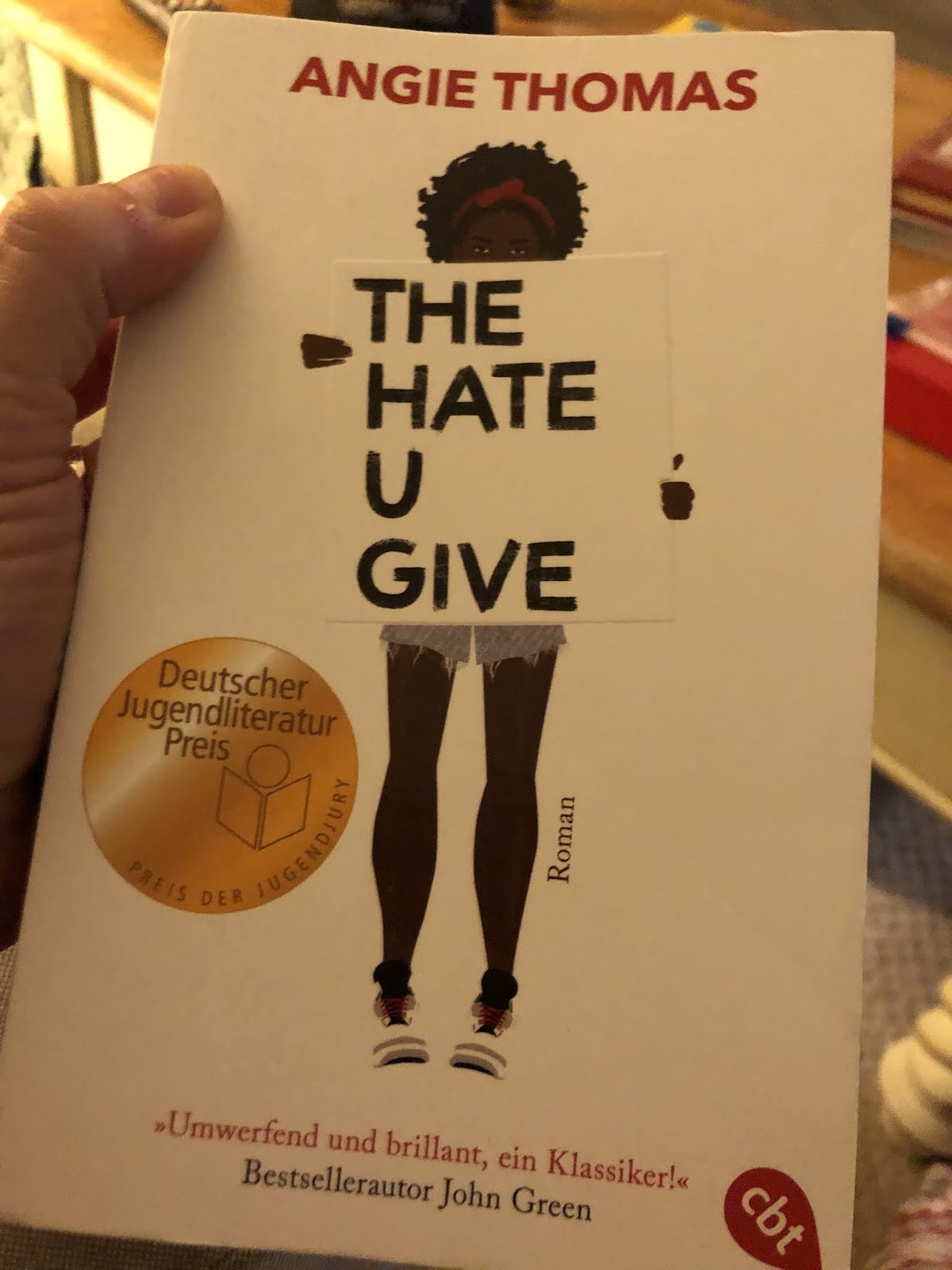
The Hate U Give
Funny story: I ordered this book, recommended by a friend at Thanksgiving time, on Amazon.
Unfortunately I received the
German version!
It sat on my coffee table for weeks waiting for me to have time to read it, until finally, on Christmas night, Meredith picked it up and said, “Mom, this isn’t English!”
So, Amazon gave me my refund and didn’t even require me to send it back! Turns out there’s a German lady in Lisa’s book club who I passed it along to. During February vacation, I downloaded it—in English—from CLAMS and finally read it!
This book opened my eyes to the thoughts and behaviors of adolescents, of all races, while also illuminating the issues of racial inequality and police brutality. I especially loved the portrayal of the main character's relationship with her family and her usage of Tumblr as a creative outlet. Throughout the book, she endures being caught in the middle of a terrifying series of events after witnessing the death of a friend at the hands of the police.
The School Library Journal summarizes the story better than I can: After Starr and her childhood friend Khalil, both black, leave a party together, they are pulled over by a white police officer, who kills Khalil. The sole witness to the homicide, Starr must testify before a grand jury that will decide whether to indict the cop, and she's terrified, especially as emotions run high. By turns frightened, discouraged, enraged, and impassioned, Starr is authentically adolescent in her reactions. Inhabiting two vastly different spheres—her poor, predominantly black neighborhood, Garden Heights, where gangs are a fact of life, and her rich, mostly white private school—causes strain, and Thomas perceptively illustrates how the personal is political: Starr is disturbed by the racism of her white friend Hailey, who writes Khalil off as a drug dealer, and Starr's father is torn between his desire to support Garden Heights and his need to move his family to a safer environment. The first-person, present-tense narrative is immediate and intense, and the pacing is strong, with Thomas balancing dramatic scenes of violence and protest with moments of reflection. The characterization is slightly uneven; at times, Starr's friends at school feel thinly fleshed out. However, Starr, her family, and the individuals in their neighborhood are achingly real and lovingly crafted.
VERDICT Pair this powerful debut with Jason Reynolds and Brendan Kiely's All American Boys to start a conversation on racism, police brutality, and the Black Lives Matter movement.—Mahnaz Dar, School Library Journal
Update: August 2021 The movie is even better than the book. Kudos to the casting director for choosing real actors to portray the multi-dimensional real characters in this story. It drives home the importance of the subject matter makes the resulting film that much more poignant...and real.
Wednesday, January 8, 2020
The Rosie Project: A Novel
The Rosie Project: A Novel by Graeme Simsion is the second book I read during my extra long Christmas break this school year—third if you count my rereading of The Little Prince. Technically I didn't finish reading it until the week after vacation was over, and I was actually falling asleep trying to get from the climax to the resolution! Can you say, "post-coital zombie"?
I really wanted to like this book, and it had me laughing in some parts, but not enough to give it a rave review. By the end, I was like Ricky Gervais at the Golden Globes, “I don’t care anymore.” The quirks of the spectrum-y main character and the snarkiness of his love interest started to wear thin and I got bored with their schtick. "I just didn't care anymore."
Subscribe to:
Posts (Atom)